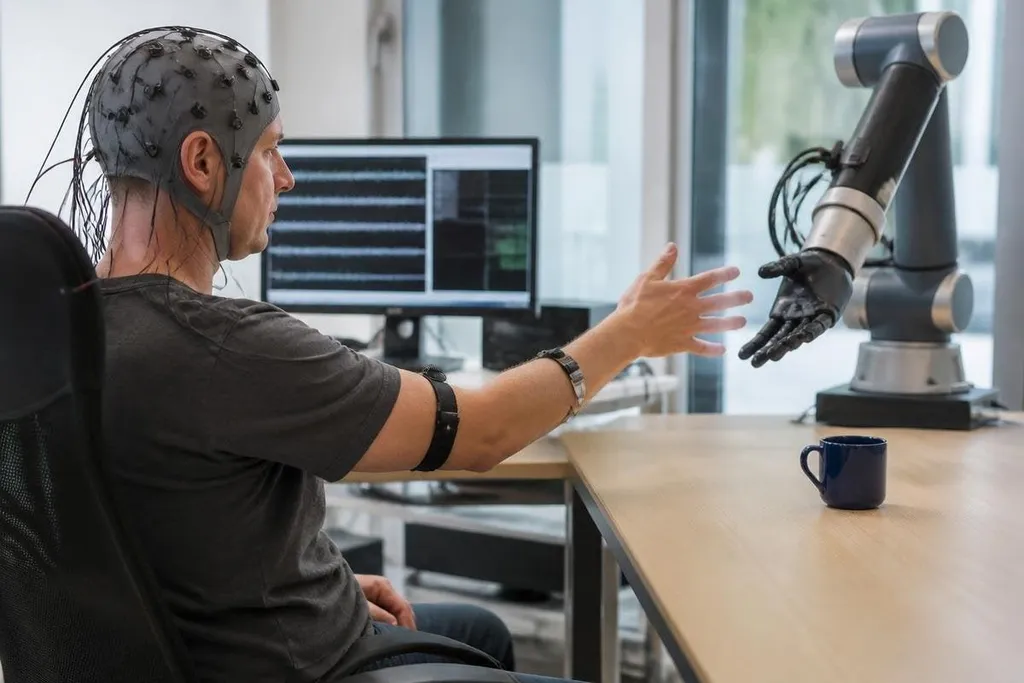
A robotic arm can move after a computer reads signals from the brain, muscles, or nerves. The difficult step comes next: making the limb move in a useful way and helping the person sense what it touches.
- Brain signals can guide a cursor, arm, or hand
- Electrodes turn nerve activity into computer commands
- Touch and position feedback still limit daily use
Where the signal comes from
A person decides to reach for an object. That decision creates patterns of electrical activity in the nervous system. A control system records those patterns and maps them to an action such as moving a wrist, opening a hand, or turning an elbow.
There are three main places to read the signal. Electroencephalography, or EEG, uses sensors on the scalp. It avoids surgery, but the skull weakens the signal and several brain activities overlap. Electromyography, or EMG, reads electrical activity in muscles. It can help control a prosthetic hand when some muscle movement remains.
Intracortical electrodes sit inside the brain and record activity from individual neurons or small groups of neurons. They can carry more detailed movement information, but placing them requires surgery and long-term signal quality can be hard to maintain.
The source changes the job for the computer. EEG may give a broad command such as “move left.” A signal from motor areas of the brain can carry more detail about direction, speed, or hand shape, though the system still needs training for each person.
How the control loop works
The computer first filters the raw signal. Electrical noise can come from muscle activity, loose sensors, movement, or nearby equipment. Software then finds patterns linked to the person’s intended action and sends a command to the robotic limb.
That command usually controls several motors. A hand may need separate movements for the thumb, fingers, wrist, and palm. The software turns one neural pattern into a set of motor positions, speeds, and force limits.
The person often learns the system at the same time. They repeat a movement while the computer adjusts its model. A stable command set matters because a small signal change can move the hand in the wrong direction or stop a grip too early.
This is why a neural interface is a control loop, not a wire from brain to motor. The system reads intent, moves the limb, checks the result, and needs another signal from the person or the sensors before the task is finished.
Feedback makes the limb useful
A natural hand sends touch, pressure, temperature, and joint-position signals back to the nervous system. A robotic limb has sensors that can measure some of these things, but the person must receive that information through another channel.
One method sends electrical pulses to nerves near the missing limb. Another uses vibration on the skin to represent grip force. Visual feedback also helps, but watching a hand is slower than feeling an object slip.
The gap shows up in ordinary tasks. A person may move a robotic hand to a cup.
Gripping the cup requires enough force to hold it without crushing it. The control system needs position and force data, while the person needs a clear signal that the grip is safe.
A neural limb claim needs more than a finger moving on cue. Robot 24 reports can connect the recorded signal, limb task, test setting, and measured result. That record leads into the limits that still shape this approach.
What still limits the approach
Signal quality changes with sweat, sensor position, muscle fatigue, and movement. A system trained in a lab may behave differently during cooking, walking, or working at a bench. The computer also has to separate an intended movement from nearby nerve activity.
Surgery adds another limit for brain and nerve interfaces. Doctors must place electrodes safely, and the hardware must keep working inside the body. The system needs a way to charge, repair, or replace parts without creating new medical risks.
Cost and setup time matter too. A useful limb needs motors, sensors, control software, a power system, and clinical support. A brief demonstration can show that a signal moved a joint. It doesn't prove that a person can use the limb for hours each day.
I'd judge a neural limb by the tasks a person can complete repeatedly, not by how smoothly one test movement looks.
A practical check before calling it ready
Use these questions when you assess a neural-control system:
- Signal source: Does it read EEG, EMG, peripheral nerves, or brain activity?
- Control detail: Can the person set speed, direction, grip force, and release?
- Feedback path: Does the person receive touch or force information?
- Failure response: Does the limb stop safely when the signal becomes unclear?
- Daily use: Has the system worked during tasks outside a controlled test?
- Care plan: Who handles fitting, software updates, repairs, and medical checks?
The next useful step is better feedback paired with simpler control. A limb that lets someone grasp one cup may be a valid result; a limb that keeps working across many tasks is the harder standard.